Bounds on System Reliability
[Editor's Note: This article has been updated since its original publication to reflect a more recent version of the software interface.]
Information for reliability block diagrams often comes from a mixture of sources, including in-house testing, manufacturer data or reliability prediction methods. For any component with information that comes from a manufacturer or a reliability prediction, only the parameters (e.g. MTBF for an exponential distribution or β and η for a Weibull distribution) are available for that component. Without the actual failure times that were used to compute these parameters, it is impossible to compute the variance of reliability for that component.
In order to compute bounds on system reliability, it is necessary to know the expected value and the variance of reliability for each component in the system, so the bounds on system reliability are not available in these cases. The bounds on system reliability can be obtained, however, for the special case where all the times-to-failure data for all the components in the system are available. There are several methods to compute these bounds. In this article we will use a simple example to illustrate the method used in Weibull++.
The basic steps to calculate bounds on system reliability are as follows:
- Obtain the parameters and the variances and covariances of those parameters for each component in the system.
- Compute the variance in reliability for each component in the system.
- Obtain an expression for the variance in system reliability.
- Use the logit transform to obtain the bounds on system reliability.
Example
On the day before Julie’s boss went on
vacation, he assigned her a new project. He wanted Julie
to take the subsystem test data that had just come back
from the lab and figure out what the 95% one-sided lower
confidence bound on system reliability would be at 150
hours. Julie knew that she could use the reliability
block diagram feature in Weibull++ to compute this information
quickly, but she was curious about how these values were
calculated. Since she had a very simple system, she
decided to try to do the calculations step-by-step and
compare them to the results of the block diagram.
Step 1: Table 1 shows the times-to-failure for both subsystems.
Table 1: Times-to-Failure for
Subsystems 1 and 2
| Subsystem 1 | Subsystem 2 | ||||
| 72 | 171 | 313 | 3 | 204 | |
| 106 | 187 | 316 | 5 | 234 | |
| 110 | 214 | 335 | 25 | 239 | |
| 134 | 218 | 346 | 61 | 257 | |
| 147 | 225 | 386 | 71 | 316 | |
| 150 | 245 | 426 | 97 | 634 | |
| 160 | 262 | 149 | |||
| 161 | 306 | 186 | |||
Julie pasted the data into two Data Sheets in a single Standard Folio in Weibull++. She calculated the Weibull distribution parameters for each data set as shown in Figures 1 and 2. She found that for subsystem 1, β = 2.5663 and η = 254.8755 hours, and for subsystem 2, β = 0.7605 and η = 183.5255 hours.
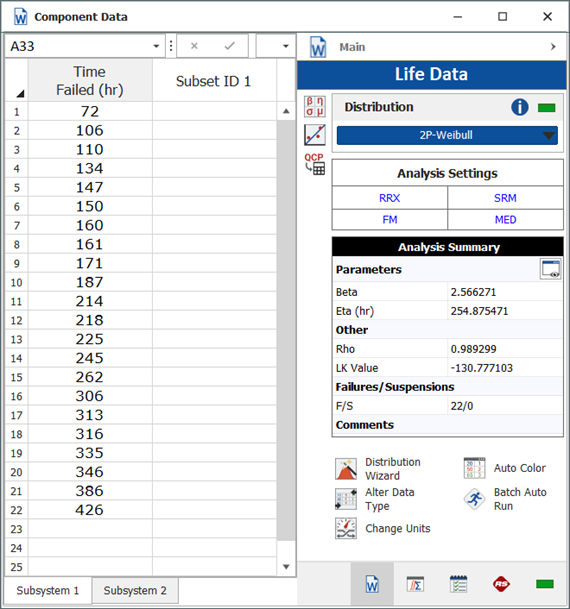
Figure 1: Data for
Subsystem 1
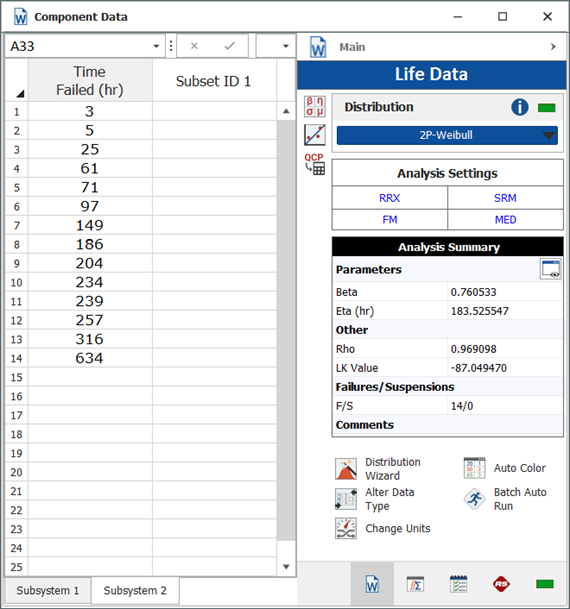
Figure 2: Data for Subsystem 2
Next, Julie found the reliability for each subsystem at 150 hours using the QCP, as shown in Figure 3.
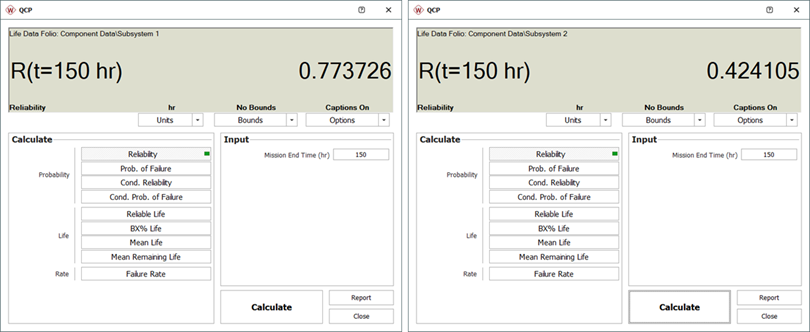
Figure 3: Reliability for Subsystems 1 and 2 at
150 Hours
Finally, Julie needed to obtain the variances and covariances of the parameters for each subsystem. These values are estimated from the inverse of the local Fisher matrix. (For more information about the Fisher matrix, please see the Confidence Bounds for Competing Failure Modes section at http://reliawiki.org/index.php/Competing_Failure_Modes_Analysis). She clicked the Show Fisher Matrix button on the Confidence Bounds page of the QCP to obtain the following:
Table 2: Fisher Matrices for Subsystems 1
and 2
| Subsystem 1 | Subsystem 2 | |||
| Var(β)=0.1845 | Cov(β,η)=3.2355 | Var(β)=0.0307 | Cov(β,η)=0.6821 | |
| Cov(η,β)=3.2355 | Var(η)=497.8763 | Cov(η,β)=0.6821 | Var(η)=5420.7728 | |
Step 2: At this point, Julie dusted off her old statistics book to help her determine the variance of reliability for each component. She turned to the page that had the formula for the variance of a function of multiple variables. In general:

For the Weibull distribution:

Since the Weibull reliability is:
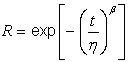
Julie was able to compute the partial derivatives as follows:
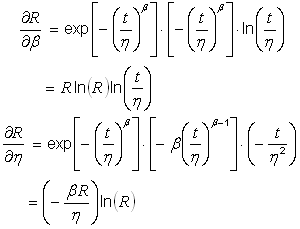
Substituting these into the expression for variance yields:

Using the values she obtained in Step 1, Julie computed the variance of reliability at 150 hours for each subsystem. She found that for subsystem 1, Var(R) = 0.0053922 and for subsystem 2, Var(R) = 0.0126361.
Step 3: The subsystems are arranged reliability-wise in parallel, so the equation for the reliability of the system is:
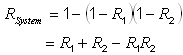
Once again, Julie turned to the formula for the variance of a function of multiple variables. Since the component reliabilities are independent, the covariance terms are zero. Therefore, for her system:
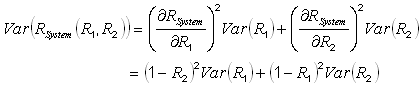
Thus Julie determined that at 150 hours, RSystem = 86.969% and Var(RSystem) = 0.0024353.
Step 4: Julie knew that the logit transform is used to find the bounds on reliability given an expected value and variance of reliability. Therefore, the expression for the lower bound of system reliability is given by:
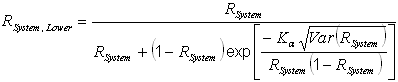
where Kα is defined as:
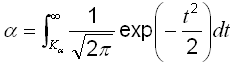
For a one-sided bound, α = (1 – confidence level), so she used α = 0.05 as the input for the Quick Statistical Reference to determine the value of Kα as shown in Figure 4.
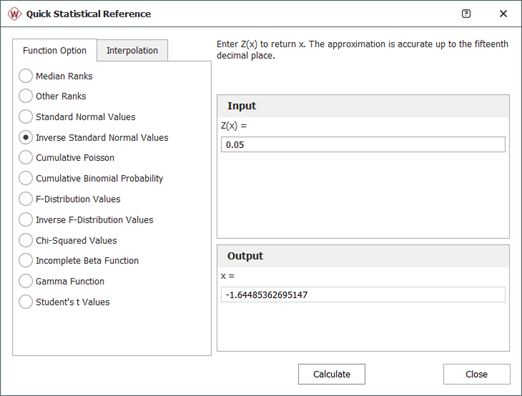
Figure 4: Calculation of Kα for a 95%
One-Sided Lower Bound
Julie now had everything she needed to compute the lower bound of the system reliability. Plugging the values into the equation for the lower bound of the system reliability at a 95% confidence at 150 hours, Julie found that the lower bound on reliability was 76.53%.
Verification
Julie created a new block diagram with her subsystems in
parallel, as shown in Figure 5.
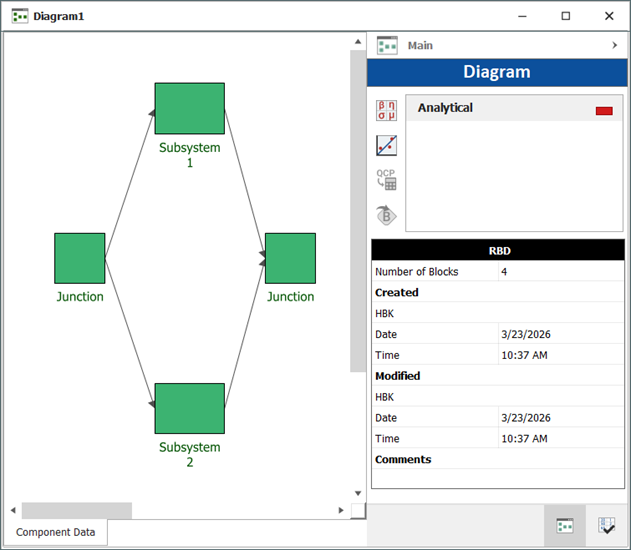
Figure 5: Block
Diagram for Parallel Subsystems
She calculated the diagram and opened the QCP. She set up a 95% lower one-sided bound and computed the reliability of the system as shown in Figure 6. Julie was pleased to find that her calculations matched those of Weibull++, and confident that she understood how confidence bounds on system reliability are obtained.
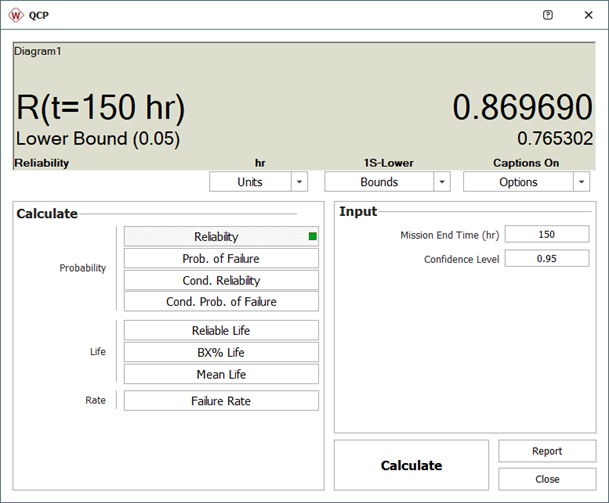
Figure 6: System
Reliability and 95% Lower One-Sided Confidence Bound